Tokenized assets: how a share, a deposit, or even a building becomes digital
Shares, artwork, real estate… in fact pretty much any asset, can now have a digital twin. Tokenization is reshaping investments by making it possible to split tangible, real-world assets into tokens that can be bought or sold in a matter of seconds, with the utmost transparency and with no intermediaries. So what are the steps involved in turning tangible value from the physical world into its digital counterpart?

A tokenized asset is a unique, secure digital representation of the value of a real asset. In practice, it works as a kind of proxy that carries the value and associated rights of that asset, but operates on a blockchain network where every transaction is automatically recorded. Key benefits include:
- Transparency and traceability: every transaction is captured on the blockchain.
- Fractional ownership: investors can hold only a portion of the asset.
- Faster transfers: near-instant and intermediary-free.
Given these enticing benefits, a growing number of banks, companies and regulators are busy looking at how to convert not only money but also shares, bonds, artwork and real estate into tokens.
For example, a single share in a company might be split into 100 tokens, each worth one-hundredth of the value of the original security, or a bank deposit could be converted into a token representing euros held in a regulated account. In the real estate sector, tokenization allows investors to buy fractions of buildings, trade them around the lock on secondary markets, and receive their share of the rent automatically through a smart contract.
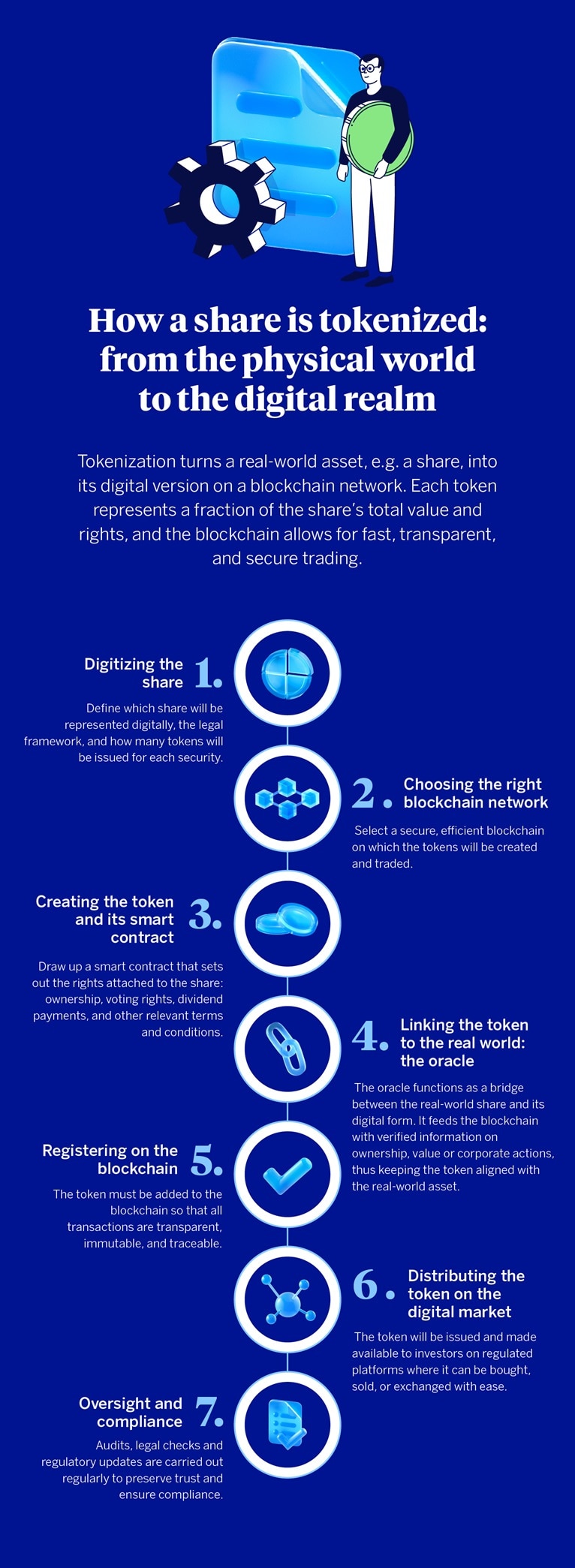
How to tokenize an asset, step by step
1. Identify the asset
The first step is to decide which asset you want to be represented digitally, how many tokens will be issued, and what rules will govern their use. It’s crucial to choose an asset that is legally registered and held by a custodian so that each token corresponds to something real (perhaps a company’s shares).
2. Choose a blockchain network
Selecting the network is key, as it determines how the tokens will be created and managed. The platform must be secure, efficient, and compliant with market standards, such as Ethereum with its ERC-20 or ERC-721 tokens.
You also need to be wary of other factors: transaction costs and speed, the ecosystem of tools and compatible wallets, and the level of regulatory compliance or ‘permissioning’ that the network supports, which is especially important when working with real-world financial assets.
3. Create the token
The token must be linked to a smart contract, which sets out the conditions under which the token will operate (e.g. shareholder ownership rights, dividend payments, or voting rights at AGMs).
4. Link it up to the real world
To preserve the link to the actual asset, the smart contract relies on ‘oracles’, which are systems that feed verified real-world data into the blockchain, such as the current value or ownership status of the asset. These oracles see to it that whatever happens to the real asset is reflected in its digital counterpart. Without them, the token could drift away from its real-word counterpart. For instance, a share might be sold or a deposit withdrawn while the token remains unchanged.
5. Register it
Each token must be recorded on the blockchain to ensure its integrity, immutability and traceability. Once recorded, you can verify at any time who owns the share-linked token and how it has changed hands. When the time comes to settle a transaction, the smart contract executes the settlement automatically and securely.
6. Distribute it
The asset tokens can now be distributed through a digital marketplace where investors are free to buy, sell or trade them using a digital wallet. It is crucial to ensure that all issuing and trading complies with prevailing financial regulations of the jurisdiction in which the company operates. This ensures the legitimacy of the process and protects investors.
7. Oversight and compliance
Once up and running, tokens undergo regular compliance checks, including audits, legal reviews and updates to the smart contract, whenever the underlying asset changes or the regulatory framework evolves.
Towards a borderless digital market
Tokenization brings us closer to a world in which assets can move seamlessly across platforms and jurisdictions, supported by shared legal frameworks that protect investors and help to build trust. Achieving this vision calls for common standards, robust technological infrastructure and ongoing collaboration among banks, regulators, and technology firms.
Against this backdrop, tokenized assets will not only transform how people invest, but also how we view ownership, liquidity and value within a truly digital economy.