South Korean composer Unsuk Chin wins the Frontiers Award for Music and Opera
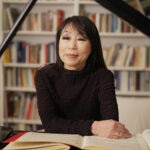
The BBVA Foundation has awarded its Frontiers of Knowledge Award in Music and Opera to Unsuk Chin. The South Korean artist, who taught herself to play the piano and compose, has developed a “singular technique of great solidity” defined “by her refined command of sound and masterful ability to transform it into a play of illusions and metamorphoses, marking her out as one of the great innovators in contemporary music,” the award committee noted.

Unsuk Chin's career (Seoul, South Korea, 1961) began with the piano her father, a Presbyterian minister, bought for the church where he preached. Chin was only two years old at the time. “Shortly after, I began learning to play on my own. My father could read sheet music and taught me a little, but I was basically self-taught until I started university. As a child, all I wanted was to become a pianist, but my family, like most families in South Korea in the sixties, was quite poor and couldn't afford lessons,” the laureate recounts.
When she was 12, her music teacher at school suggested she try her hand at composition. “At the time, I had no idea what that involved, but I told myself it would be much cheaper than becoming a pianist,” she jokes.
Despite having to balance school with a job to help support her family, Chin managed to gain admission to Seoul National University. The composer recalls this period as a very difficult but also enriching time: “We were under a military dictatorship and faced very serious political problems.” However, it was there that she discovered Western contemporary music, which inspired her to pursue her career in Europe.
The difficult path to finding her own voice
In 1985, Chin received an exchange scholarship from the German government and moved to Hamburg, where the Hungarian composer György Ligeti took her on as a student. Working with Ligeti was not easy. “I found him quite intimidating. I studied with him for three years, and his lessons were very demanding. Maybe it wasn't his fault. As a Jewish survivor of World War II, he hadn't had an easy life, and part of his family had been murdered by the Nazis.” Despite everything, “studying with him was the best thing that could have happened to me in my entire life, because even today I continue to learn from his music and his teachings," the award winner reflects.
After finishing her studies with Ligeti, she moved to Berlin, where she began working as a freelance composer at the Electronic Music Studio of the Technical University of Berlin. In the 1990s, Akrostichon-Wortspiel (“Acrostic-Wordplay,” 1991–93) marked the beginning of her international career. Since then, this piece has been performed by ensembles around the world.
A body of work inspired by dreams, science, and literature
Among her sources of inspiration are dreams—“they've been fundamental to all my music”—and science, especially physics and astronomy. “Whenever I've been frustrated and under a lot of stress, I'd read a book about the Big Bang or the universe before bed, and that would put everything into perspective—I could sleep peacefully,” Chin explains.
She also highlights how deeply she was marked by the correspondence between the Austrian physicist Wolfgang Pauli, winner of the 1945 Nobel Prize, and the Swiss psychiatrist Carl Gustav Jung: “I find Pauli a fascinating figure; he was a scientific genius but also a tormented artist—disturbing dreams, troubled relationships with women, problems with alcohol and other drugs, you name it. He lived a sort of Dr. Jekyll and Mr. Hyde existence: by day a professor, by night a party animal in Hamburg. His story and his relationship with Jung inspired me to write my latest opera, Die dunkle Seite des Mondes.”
Exploring the limits of what is musically possible
Unsuk Chin's first opera, Alice in Wonderland (2007), brings together all of the artist's obsessions: it begins with the protagonist's dream and weaves philosophy and science into the dreamscape. “When I was studying with Ligeti, he used to talk to us about that work. On the surface it had a simple, fairy-tale plot, but underneath there were deep connections to many fields, including mathematics,” the composer recounts.
In this work, Chin expands the use of the voice through extended techniques and contrasts between lyricism and spoken text. “I always try to go beyond the limits of what is singable. In a contemporary opera, you can do anything—including speaking, making strange sounds, or shouting.”
Chin describes her creative process as a trance that begins with the first note and ends with the last, without interruption. Known for pushing her performers to their limits in her concertos for solo instruments, she admits that, just as she drives herself beyond her own limits when composing, she expects a similar effort from the musicians: “I'm very demanding of myself, and I expect the same attitude from the performers — that's why many of them hate me.”