The Frontiers of Knowledge Awards Champion Science and Culture as Engines of Progress in Uncertain Times
Carlos Torres Vila hailed the transformative, unifying power of science and culture at the ceremony for the 18th BBVA Foundation Frontiers of Knowledge Awards. At a time marked by complexity and uncertainty, the President of the BBVA Foundation reminded the audience that progress springs from human creativity, from rigor, and from collaboration between people, disciplines and countries.

“Geopolitical tensions, environmental challenges, social polarization and the rise of disinformation are transforming our societies,” Carlos Torres Vila said at the ceremony, held at the Euskalduna in Bilbao. Against this backdrop, he affirmed that “the values we celebrate today are more vital than ever. We celebrate curiosity over conformity. Rigor over oversimplification. Evidence over prejudice. Cooperation over fragmentation. And creativity as a force that can open new possibilities for the future.”
During the ceremony, which honored 10 figures and two institutions at the forefront of scientific research and artistic creation, the Chair of the BBVA Foundation also emphasized that these awards “represent far more than academic recognition. They are also an expression of confidence – confidence in the human capacity to discover, innovate and create. Confidence in science and culture as tools to expand opportunities and face the major challenges of our time.”
The ceremony was co-chaired by the President of the BBVA Foundation and Eloísa del Pino, President of the Spanish National Research Council (CSIC). It opened with an address by the Mayor of Bilbao, Juan Mari Aburto, and closed with remarks from the Lehendakari, or President of the Basque Government, Imanol Pradales.
The President of the CSIC highlighted “curiosity as the engine of science” and made the case for protecting “the freedom to be curious” in the face of threats such as the culture of immediacy, the risks posed by the misuse of artificial intelligence, and “the censorship and defunding of science that we have witnessed in recent years, even in the West.”
The Lehendakari congratulated the 12 winners on “their outstanding contribution to the progress of humanity,” noting that their work is helping to build a more cohesive world, one better equipped to face the challenges ahead. Work that also speaks to the pillars on which the Basque people are built. “For us, the Basque people, science, philosophy and the arts are pillars of humanism and of a model of society that places people at its heart,” the Lehendakari concluded.
The ceremony also drew many members of the international juries across the awards' eight categories, from some of the leading universities and research centers in Europe and the Americas. The more than 1,000 guests included leading researchers, academics, artists, science-policy and scientific-society officials, business leaders and members of the media.
All the winners of the 18th Frontiers Awards
The winners include the researchers who revolutionized cancer treatment with CAR-T cell therapies; the pioneers who discovered the so-called “magic angle” that can transform the properties of new materials; the creators of the cryptographic system that underpins the security of the digital world; and the scientist who spearheaded our understanding of climate change's impact on the oceans.
The awards also honored landmark contributions to the scientific measurement of public opinion and social life; the rigorous integration of uncertainty into economic analysis and public-policy evaluation; the advancement of scientific rationality through philosophy; and, in the arts, the innovative, cosmopolitan body of work of composer Unsuk Chin.
- Basic Sciences: Allan MacDonald and Pablo Jarillo-Herrero.
- Biology and Biomedicine: Carl June and Michel Sadelain.
- Information and Communication Technologies: Joan Daemen and Vincent Rijmen.
- Climate Change and Environmental Science: Carl Wunsch.
- Economics, Finance and Business Management: Charles Manski.
- Humanities: Nancy Cartwright .
- Social Sciences: Institute for Social Research at the University of Michigan and NORC at the University of Chicago.
- Music and Opera: Unsuk Chin.
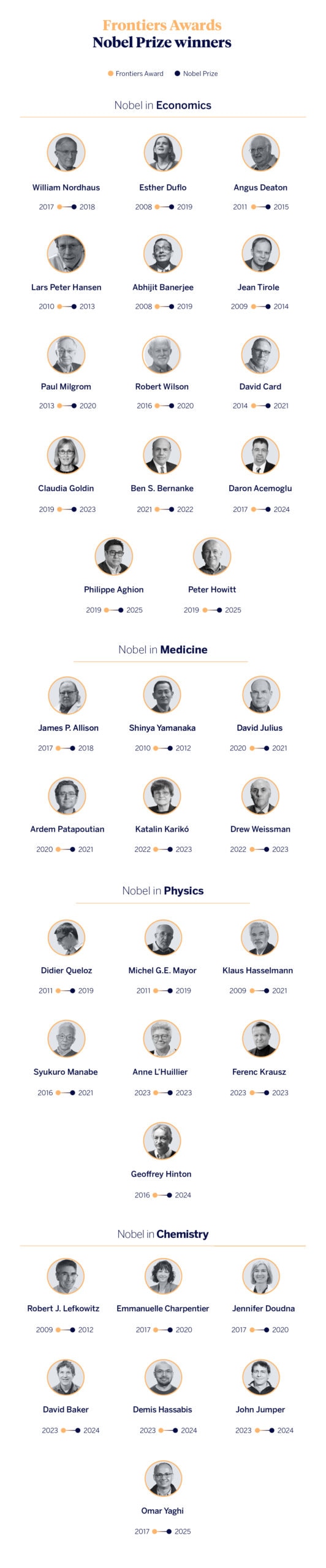
34 Frontiers winners have gone on to win the Nobel
One external measure of the standing of the Frontiers of Knowledge Awards is that 34 of the researchers honored by the BBVA Foundation went on to win the Nobel Prize.
Fourteen Frontiers Award winners have since won the Nobel Prize in Economics: Lars Peter Hansen (2013), Jean Tirole (2014), Angus Deaton (2015), William Nordhaus (2018), Abhijit Banerjee and Esther Duflo (2019), Paul Milgrom and Robert Wilson (2020), David Card (2021), Ben Bernanke (2022), Claudia Goldin (2023), Daron Acemoglu (2024), and Philippe Aghion and Peter Howitt (2025).
In the case of the Nobel Prize in Medicine, six Frontiers Award winners later went on to receive the Swedish Academy's prize: Shinya Yamanaka (2011), James P. Allison (2018), David Julius and Ardem Patapoutian (2021), and Katalin Karikó and Drew Weissman (2023).
In the case of the Nobel Prize in Physics, seven Frontiers Award winners later received the Swedish Academy's prize: Didier Queloz and Michel G. E. Mayor (2019), Klaus Hasselman and Syukuru Manabe (2021), Ferenc Krausz and Anne L’Huillier (2023), and Geoffrey Hinton (2024).
Finally, in the case of the Nobel Prize in Chemistry, seven Frontiers Award winners later received the Swedish Academy's prize: Robert J. Lefkowitz in 2012, Emmanuelle Charpentier and Jennifer Doudna in 2020, David Baker, Demis Hassabis and John Jumper in 2024, and Omar Yaghi in 2025.