Clean technologies, or cleantech, are no longer just solutions that help lower emissions. They have become a key component in economic and geopolitical transformation. The first edition of the European Clean Tech Atlas 2026, published by the Bruegel think tank offers an in-depth look at their deployment and the challenge of combining decarbonization, industrial competitiveness and energy security.

Cleantech includes technologies such as solar and wind energy, batteries, electric vehicles, heat pumps, advanced electric grids, clean hydrogen and low carbon industrial processes. This entire ecosystem of products, services, processes and business models is no longer simply a climate project. It is evolving into an industrial and strategic issue, with implications for the global energy market. The economic dimension of this transformation is already substantial: global investment in cleantech reached €1.8 trillion in 2025, while the global market value of these technologies was €1.1 trillion.
This is the main thesis of the European Clean Tech Atlas 2026, a report written by researchers from Bruegel, a European think tank and research center specializing in economics and based in Brussels. The institution analyses how cleantech is transforming the European energy system, the industrial structure of the continent and its trade ties with the rest of the world. The research is based on the premise that electrification and the gradual replacement of fossil fuels represent an enormous economic opportunity, but they also pose challenges related to technological dependence, supply chains and industrial competitiveness.
In its first edition, the Atlas tracks investments in cleantech facilities and combines its data with official figures from Eurostat (the European Union’s statistics office), the International Energy Agency (IEA) and independent organizations such as Global Energy Monitor (GEM), Ember and Rhodium Group. The structure of the study covers the adoption of clean technologies by companies and consumers, European capacity to manufacture them on an industrial scale, and the international context in which this transition toward a cleantech-based economy is developing.

A Europe that still relies on fossil fuels
Europe is facing the energy transition while still constrained by its heavy reliance on external energy supplies. The growth of renewable energy is taking place alongside an economy that depends on imported oil and gas. According to the research, in 2025, European imports of fossil fuels surpassed €350 billion – equivalent to €1,750 annually for each European household. Oil alone accounted for €231 billion, compared to €104 billion of natural gas and €18 billion of coal.
Recent energy crises have accelerated the search for alternatives. The disruption of Russian gas supplies following the invasion of Ukraine led to sharp increases in energy prices in 2022, while subsequent geopolitical tensions have once again put the spotlight on the vulnerability of fossil fuel energy markets.
Electricity currently represents 23 percent of the European Union’s energy consumption and “this percentage is likely to increase in the coming years as transportation, heating and industry become more electrified,” the report states. The European Commission’s projections point to a much more electrified economy in line with 2050 climate targets, with an electrification rate around 60 percent.
In 2025, electricity generated in the European Union was distributed as follows:
- Wind: 17%
- Solar: 12%
- Nuclear: 23%
- Hydropower: 12%
- Bioenergy: 6%
- Fossil fuels: 29%
Electrification as the backbone of change
The Atlas identifies electrification as an essential element in the European energy transition. While in China the percentage of energy consumed as electricity increased from 19 percent in 2011 to 29 percent in 2023, while in the European Union, where the average has remained stagnant for the past decade, the pace by country is uneven. For example, Norway leads in electrification thanks to the high penetration of electric vehicles, heat pumps and electric industrial solutions. Sweden and Finland follow similar patterns. Bulgaria stands out due to a relatively limited domestic gas network, which has led to greater use of electricity in residential heating.
In addition to electricity demand, supply is also significant, supported by the availability of renewable resources and policies to promote their development.
Researchers from the Bruegel think tank argue that the entire energy system must be transformed so that electricity can directly replace fossil fuels in heating buildings, moving vehicles, lighting, and producing goods. Some of the measures include:
- Producing low-emission electricity
- Creating infrastructure capable of transporting it to consumers and using it to provide ‘useful energy services’ (transportation, heating).
Cleantech growth is closely linked to rising electricity consumption and to the increasingly important role of electricity in the economy, as the authors of the report acknowledge.
Deployment is advancing in solar, wind and energy storage
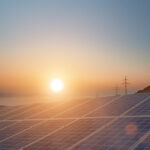
In 2025, solar energy accounted for 12 percent of Europe’s electricity demand, following two waves of expansion. As the report recognizes, the first wave was driven by public support programs in the 2000s, which helped create the initial market and lower the overall costs of the technology.
A second phase of growth began in 2019 due to falling prices and new support programs. Last year, Europe had 380 GW of solar capacity connected to the grid, equivalent to around 0.7 kW per capita. This is roughly the amount of power needed to power 70 LED lightbulbs. Approximately 60 percent of this capacity is installed on rooftops, with the remainder in large solar plants.
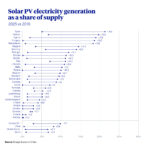
Spain tops the list of countries with the greatest growth in solar power generation, up more than 16 percent between 2019 and 2025, followed by Greece, Cyprus, Hungary and the Netherlands. Growth in this renewable energy source surpasses that seen in other large economies.
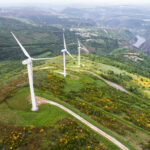
Wind energy also continues to play a central role and is now considered a mature technology in Europe. In 2025, it provided 17 percent of Europe’s electricity. Around 90 percent of the installed capacity comes from onshore wind farms, although offshore wind accounts for a significant portion of new investment, particularly in the North Sea.
Denmark remains a leader in this area: wind turbines produce over half of its electricity. The Netherlands, Finland, Sweden and Lithuania have posted some of the greatest growth.
As renewable energy production rises, so does the need for storage systems. Lithium-ion batteries have gained prominence because they can respond rapidly to fluctuations in electricity supply and demand. “While pumped-storage hydropower systems have been used for decades and can store energy for long periods of time, lithium-ion battery systems are especially effective at absorbing and releasing electricity very quickly,” the authors of the Atlas explain.
In 2024, Europe had 60 GWh of stationary storage connected to the grid, although the cumulative capacity of electric vehicle batteries was much higher, with around 600 GWh.
The cleantech industry: a new economic geography
Since 2016, companies have invested around €118 billion in European clean technology manufacturing facilities, including batteries, electric vehicles, solar panels, wind turbines and low-emission iron.
Germany accounts for the highest level of investment, with more than €25 billion since that year. In 2026, the largest projects underway are in Hungary and Spain. The battery industry is one of the key sectors. Hungary has emerged as a European hub and is home to the continent’s largest battery cell manufacturing capacity. Sweden and Finland have a highly specialized workforce, with a greater percentage of workers employed in the electricity generation and storage equipment sector. In the electric vehicle sector, Europe has sufficient industrial capacity to produce around four million electric vehicles per year, compared to an internal demand of nearly three million. Germany has the greatest manufacturing capacity, followed by France and Spain.
The international context: China, the U.S. and the new technological competition
One of the pillars of the clean transition is international trade, which largely depends on global supply chains. According to data from the European Cleantech Atlas, in 2024 the EU:
- Exported €82 billion of clean technologies
- Imported €90 billion
- Trade deficit of €8 billion
China is the top supplier of cleantech products for Europe. Of the total amount of cleantech imports, 60 percent (€54 billion) came from the Asian powerhouse. Why? Because of its industrial capacity. “In recent decades, China has developed an enormous cleantech manufacturing industry. This has allowed it to produce massive volumes, reduce costs and accelerate the roll-out of these technologies.” This enables Europe to access them at competitive prices. Bruegel experts note that “if a significant portion of cleantech is manufactured outside Europe, the transition could depend on industrial, commercial or geopolitical decisions in other countries.” In short, the EU is accelerating its transition, but a significant share of these technologies comes from a single supplier outside Europe.
Here is how the clean-tech landscape looks country by country.
- China: industrial powerhouse of the transition. The researchers say China combines rapid electrification with vast manufacturing capacity. In 2023, electricity met 29% of its energy demand, compared with 23% in Europe. In addition, half of all new vehicles sold in China in 2025 were battery-electric vehicles. At the same time, China remains heavily dependent on coal: more than half of its electricity generation still comes from fossil fuels, mainly coal-fired power plants.
- United States: momentum and a regulatory shift The United States presents a different picture. Clean sources account for 43% of its electricity generation, with solar and wind playing a growing role, although natural gas remains the leading fossil fuel used to generate electricity. The 2022 Inflation Reduction Act (IRA) spurred industrial investment and domestic clean-tech manufacturing. The report estimates that this push generated €28 billion in investment in 2023, although the subsequent withdrawal of federal subsidies slowed the pace of investment.
- Germany, Denmark, Hungary and Spain: different European models Within Europe, Germany is the main industrial hub. It is Europe’s largest net exporter of clean technologies. Electric vehicles dominate its clean-tech profile, accounting for 66% of exports, while batteries used in vehicle manufacturing make up a significant share of imports. Denmark stands out for its specialization in wind power. Wind accounts for 55% of its clean-tech exports, reflecting the sector’s strong international presence. Hungary has emerged as an important battery hub thanks to large inflows of foreign investment. Chinese companies have announced new plants there, while European and Asian manufacturers are expanding their footprint in the country. Spain has emerged as one of the leading recent destinations for clean industrial investment. Together with Hungary, it is home to some of the largest projects now under construction, particularly in batteries and electric mobility.
Europe’s challenge: preserving industrial capacity while maintaining competitive international supply chains
The European Clean Tech Atlas 2026 shows how foreign investment has been crucial to expanding domestic manufacturing capacity, particularly in batteries. “South Korean companies led global innovation in lithium-ion batteries in the 2000s and built factories in Europe during the 2010s to supply automakers. Today, South Korean companies operate two-thirds of Europe’s battery-cell manufacturing capacity,” the authors write.
At the same time, external dependence is fueling debate over economic security and technological sovereignty. The Bruegel team notes that European authorities are paying increasing attention to the risks of relying on foreign companies for strategic technologies.
One million jobs in clean tech
Employment is another important dimension of clean tech’s impact in the EU. The report says more than 950,000 people already work in the production of eight clean technologies: batteries, bioenergy, geothermal, heat pumps, hydropower, solar PV, solar thermal and wind. “Since 2010,” the report notes, “clean-tech employment has doubled and remains on a rapid growth trajectory. Out of a total EU workforce of 200 million, four in every thousand European workers are employed in clean technologies.”
Breakdown of European clean-tech employment (2023):
- Operations and maintenance: 65%
- Manufacturing: 16%
- Construction: 15%
- Research: 4%
- Recycling: <1%
The Atlas’s detailed analysis shows clearly that the clean transition is no longer just about energy or environmental sustainability. It is part of a global industrial race in which Europe must combine policies and incentives that support technology deployment, preserve manufacturing capacity and reduce supply risks. Striking that balance is not easy.
Frequently asked questions about clean tech in Europe
What is clean tech?
Clean tech encompasses technologies, products, services and processes in areas such as solar and wind power, batteries, electric vehicles, heat pumps, advanced power grids, clean hydrogen and low-carbon industrial processes.
Why is clean tech strategic for Europe?
Because its development has implications for decarbonization, industrial competitiveness and energy security. It can also help reduce Europe’s dependence on imported fossil fuels and is transforming supply chains and trade relationships.
What share of EU electricity comes from solar and wind?
In 2025, wind generated 17% of the European Union’s electricity and solar 12%. Fossil fuels accounted for 29%, while nuclear generated 23%, hydropower 12% and bioenergy 6%.
What role does China play in Europe’s clean-tech market?
China is the European Union’s leading supplier of clean technologies. In 2024, 60% of EU clean-tech imports, worth €54 billion, came from China, according to data compiled in the European Clean Tech Atlas 2026.
How much is Europe investing in clean-tech manufacturing?
Since 2016, companies have invested at least €118 billion in European clean-tech manufacturing facilities, including batteries, electric vehicles, solar panels, wind turbines and low-emission iron.
How many jobs does clean tech support in the European Union?
More than 950,000 people work in the production of eight clean technologies in the European Union. According to the report, employment linked to these technologies has doubled since 2010.