What Are COPs and What Role Do They Play in the Fight Against Climate Change
The Conferences of the Parties (COPs) are annual summits that review international agreements on climate change and promote new global measures to reduce greenhouse gas emissions and protect ecosystems.

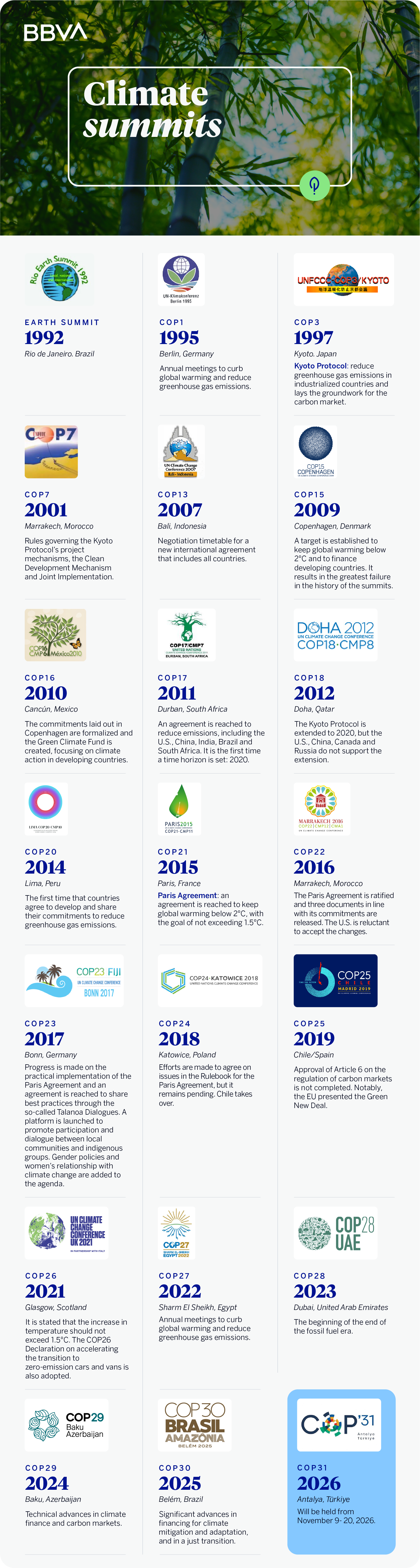
Every year, climate summits bring together governments, international organizations, companies, scientists and civil society organizations. These summits did not emerge in isolation; instead, they are the outcome of a diplomatic process that began over three decades ago, when the international community started to recognize that global warming posed a challenge that no country could face on its own.
The United Nations Department of Public Information stated that in terms of international commitment and coordination, the Framework Convention was “the most important action to date in the fight against climate change.” To trace its origins, we need to look back at the Earth Summit held in Rio de Janeiro in 1992, which achieved unprecedented global consensus in promoting sustainable development and environmental protection: Agenda 21, which was approved at the time, established a direct relationship between economic development, sustainable development, energy consumption, transport models, depletion of the ozone and global air pollution, as well as the importance of science in providing solutions. The Framework Convention was thus established and was signed by 158 nations that year. Today, 197 countries have ratified it.
COPs, a breath of fresh air for ecosystems
Two years later, the first steps were taken to achieve its objectives. These included stabilizing greenhouse gas levels in the atmosphere. The challenge included giving ecosystems sufficient time to adapt to climate change naturally, as well as ensuring food production to meet global demand and to promote sustainable economic development.
These aspirations were reflected in the 1995 Berlin Mandate, which established the need for a protocol or legal instrument for the countries’ specific commitments. This led to the 1997 Kyoto Protocol, which entered into force in 2005. Its goal was for industrialized countries to reduce total emissions of carbon dioxide (CO2) and other greenhouse gases by at least five percent from 1990 levels between 2008 and 2012.
To achieve this target, Kyoto set specific goals for countries, but they were only considered binding for the 36 most industrialized countries, based on the principle of burden-sharing and responsibility. Initially, Kyoto was set to expire in 2013, but its validity was later extended to 2020. For the second period, the most developed countries committed to reducing greenhouse gas emissions by 18 percent from 1990 levels.

EFE
The birth of COPs
The next major step in this international coordination process was establishing the annual climate summits known as the Conferences of the Parties (COPs, where ‘parties’ refers to participating countries). The first COP was approved by the 1995 Berlin Mandate, and since then, its role has been to review the implementation of agreements established under the Framework Convention and negotiate new commitments.
The term ‘summit’ is used because it brings together high-level representatives of the Convention’s signatory governments. As the signatory countries of this convention and the signatory countries of the Kyoto Protocol may not be the same, another body called the Conference of the Parties exists where those that have ratified the Protocol (COP-MOP) meet, although both meetings are held simultaneously.
Although COPs are held annually, some are considered more important than others due to the significance of their objectives or their disagreements that arose. For example, World Wildlife Fund (WWF) points to the Kyoto COP in 1997 and the Copenhagen COP in 2009 as two of the most iconic. The latter stands out because an agreement was not reached to adopt a new protocol replacing Kyoto, and because the countries did not legally commit to binding emission reductions; only to voluntary targets. The Warsaw COP in 2013 also stands out due to the impasse in negotiations to advance these goals.
The Paris Agreement and its impact on global climate action
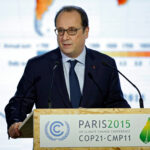
However, the most significant recent climate change summit was the one held in the French capital in 2015. There, the Paris Agreement was approved, widely regarded as a climate milestone because countries committed to limiting global warming below an average of 2 degrees Celsius, preferably 1.5 degrees Celsius, compared with pre-industrial levels. To achieve these goals, stricter emission reduction targets were adopted and for the first time, these commitments became binding. Another key provision was the requirement to set more ambitious targets every five years.
However, even though it was considered binding for all countries, numerous experts still consider its scope insufficient. “The problem is that the agreements signed at this summit are more about calling on the countries for political action than at penalizing non-compliance with the commitments. Therefore, environmental organizations feel that there is substantial risk that they are not fulfilled,” said Mar Satorra, a researcher at the Open University of Catalonia’s (UOC) Turba Lab.
Impact of the Paris Agreement on international climate policy
- Limits global warming to less than 2 ºC, preferably 1.5 ºC.
- Establishes national commitments that can be revised every five years.
- Promotes transparency mechanisms and climate financing.
- For the first time, it brings developed and developing countries together around these goals.
COP31 in Antalya (Türkiye)
The 31st edition of the Conference of Parties (COP31) will be held from November 9 – 20, 2026 in Antalya (Türkiye). Although the conference will take place in Türkiye, which is hosting the summit and holding the presidency, Australia will lead the negotiations following a selection process marked by a joint bid by Australia and the Pacific Island nations. This alliance has served to put the focus on regions that are more vulnerable to the effects of climate change. The summit is therefore expected to strengthen discussions over resilience, climate justice and international cooperation around challenges that transcend borders.

Frequently asked questions about climate COPs
What does COP mean in the climate context?
COP stands for the Conference of the Parties, the annual meetings where countries review climate change agreements and measures.
What are the main functions of the COPs?
They oversee the implementation of previous agreements, negotiate new commitments and evaluate progress in emission reduction.
What agreements have been reached in the most relevant COPs?
The Kyoto Protocol and the Paris Agreement are two of the most notable milestones, designed to limit global emissions.
What issues will be discussed at COP30?
The main topics include climate financing, climate justice, adaptation, energy transition and protection of the Amazon.
Who is financing the global fight against climate change?
According to the Paris Agreement, developed countries must take the lead in providing financing for developing countries.