How Are Agreements Negotiated at Climate Conferences?
Climate change agreements at United Nations (UN) conferences are negotiated through technical meetings, diplomatic consultations and negotiations among countries. Unlike other international bodies, decisions are not made by majority votes. Instead, they are adopted by consensus by all parties.

Images of global leaders posing for the official group photo and giving speeches from the main podium are only a small fraction of what takes places at a Conference of the Parties (COP) to the United Nations Framework Convention on Climate Changes. Behind the media spotlight and the grand opening ceremonies, the real technical and political work occurs in closed-door negotiation rooms. There, diplomatic delegations from nearly 200 countries review and discuss, word by word, complex drafts that could become international decisions with varying legal and political consequences and help guide climate cooperation.
“Unlike national parliaments and other multilateral organizations, decision-making at conferences organized under the United Nations Framework Convention on Climate Change (UNFCCC) is based on consensus among the 198 Parties (197 countries and the European Union, a regional economic integration organization).”
Unlike national parliaments or other multilateral organizations, conferences organized under the United Nations Framework Convention on Climate Change (UNFCCC) do not vote by majority. Decisions are formally adopted by consensus among the 198 Member States (197 countries and the European Union as a regional economic integration organization). This procedure allows the parties to raise objections and defend their interests during negotiations, although it can also complicate the adoption of decisions where there are significant disagreements.
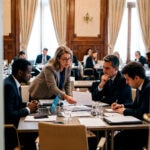
AI-generated photo
Who participates in the COP negotiations and what role do they play?
COP31, which will take place in Antalya (Türkiye), from November 9 to 20, will be organized in a slightly differently. Türkiye will hold the presidency of the summit while Australia will chair the negotiations. This division of responsibilities will allow the two countries to coordinate the diplomatic process to facilitate consensus-building among the parties.
Although thousands of people will participate, the participants in the negotiation rooms fall into three categories:
- Country delegations (parties): They include diplomats, ministers, engineers and legal experts representing their respective governments. They are the only actors with the legal capacity to negotiate the text and adopt final agreements.
- Negotiating blocs: Given the challenge of aligning nearly 200 countries, the nations are grouped into diplomatic alliances to establish common positions and strengthen their negotiating power, as outlined by the UNFCCC. Some of the most influential blocs include the Group of 77 and China, the European Union, the Arab Group, the Alliance of Small Island Developing States (SIDS), the Least Developed Countries (LDC) group, the African group and the Independent Alliance of Latin America and the Caribbean.
- Observers: They include non-governmental organizations, representatives of the scientific community, the private sector, indigenous groups and young people. However, they participate in parallel forums and provide information, with no right to vote.
To understand the dynamic of these meetings, the perspective of Bill Hare, founder and CEO of Climate Analytics, is particularly insightful. Hare is a veteran of international climate diplomacy, as he actively participated in the founding negotiations of the UNFCCC in 1992, the development of the Kyoto Protocol in 1997 and the adoption of the landmark Paris Agreement in 2015. He was also the lead author of the Intergovernmental Panel on Climate Change’s (IPCC) Fourth Assessment Report, a collective effort for which the IPCC received the Nobel Peace Prize in 2007.
Bill Hare describes the day-to-day interactions among these participants as follows: “Country delegations negotiate the text, often coordinating positions and speaking through negotiating blocs. Detailed work takes place in contact groups and informal consultations, where the presidencies prepare revised drafts as the discussions progress.” He also notes that “observers can provide technical expertise and make interventions when permitted, but they do not have a decision-making role.”
Most of this work occurs behind closed doors: “This is necessary in order to maintain the high-level of trust required for these discussions,” Hare acknowledges. Following this process, “the draft decisions ultimately go to the corresponding plenary for their formal adoption by the countries.”

AI-generated photo
What are the stages of negotiating and approving the agreements at a COP?
The adoption of a final text at a COP follows a structured process that combines technical groundwork, informal diplomacy and high-level political resolutions:
- Initial phase: adoption of the agenda and initial documents. At the start of the conference, the Convention adopts the official agenda by consensus among the parties. The initial drafts come from months of work by UNFCCC Subsidiary Bodies (the Subsidiary Body for Implementation, SBI; and the Subsidiary Body for Scientific and Technological Advice, SBSTA) or from proposals prepared by the Climate Secretariat.
- First week: during this phase, contact group meetings and informal consultations led by co-facilitators begin. This is where the paragraphs are discussed line by line. The disagreements are marked in brackets, indicating that the text has not yet been finalized.
- Second week: following these initial negotiations, the environment and climate ministers join the process. When the technical discussions reach an impasse, the COP presidency takes the lead in the process. As Hare explains, the presidency plays a decisive role in this stage. “It combines revised drafts with consultations to identify what the countries could accept. It can appoint ministers to work on complex issues, hold bilateral meetings and propose compromise wording.” Hare notes that these types of negotiations and approaches “helped steer negotiations toward a final compromise” in the Paris Agreement. The founder of Climate Analytics also stresses that “the effectiveness of the presidency depends on maintaining trust that the countries have been heard and that the text accurately reflects the negotiations.”
- Final phase: once a final text has been agreed upon during intense late-night sessions, it is presented to the plenary of the corresponding body for its formal adoption. If no delegation raises an insurmountable objection, the presidency declares the decision adopted.
The golden rule of consensus: “Nothing is agreed until everything is agreed”
In certain climate negotiations the logic of “nothing is agreed until everything is agreed” applies. This practice enables commitments on different issues to be connected, keeping partial agreements open until consensus is reached on the negotiating package. However, it does not prevent separate decisions from being adopted on other issues on the agenda.
This rule shapes the power dynamics in the meeting rooms. As Bill Hare explains: “It gives countries room to maneuver by linking commitments to the overall agreement. A delegation may accept concessions on one point if its priorities are covered elsewhere, meaning that wording that appears to have been settled could remain provisional until the end of the process.”
The consensus requirement gives countries, including small states, additional means to protect their interests through formal objections. According to the expert, “These practices encourage compromise, but they also allow countries to hold up an agreement while seeking a better outcome.”

AI-generated photo
Preparations for COP: intersessional forums and strategic alliances
The success or failure of a climate summit is not decided solely during the two weeks of a COP. It is built over months of preparatory diplomacy, bilateral meetings and scientific exchanges. Throughout this preparation process, current scientific evidence acts as a catalyst to unblock positions.
Hare underlines the practical value of scientific knowledge at the negotiating table. “At Climate Analytics, we work to ensure that governmental delegates, especially those from small island states and least developed countries, as well as the observers, have solid, reliable evidence during the negotiations.” This includes climate science on warming, feedback mechanisms and impacts as well as data and policy analysis regarding decarbonization options.
The subsidiary bodes of the UNFCCC usually meet every year in Bonn (Germany), at the headquarters of the Convention secretariat. These intersessional meetings allow for progress on technical work, drafting of decisions and the identification of disagreements that require political attention prior to the following climate conference.
The intersessional meetings at Bonn play a vital role in organizing the technical work prior to events like COP31. “Bonn is where the negotiators work on technical details, draft decisions and identify disagreements that require political attention before or during COP. The delegations coordinate within their negotiating groups and build relationships with each other through informal meetings and diplomatic contacts,” the founder of Climate Analytics clarifies.
What happens if the countries do not reach an agreement at a COP?
Despite diplomatic efforts, a lack of consensus occasionally prevents certain key points from being resolved before the official conclusion of the conference. When the parties do not reach an agreement on an agenda item, UNFCCC rules provide specific remedies. The countries can agree to continue with a topic at a subsequent session and specify which draft will serve as the basis for future work.
Bill Hare explains that if they cannot agree on this procedure, Rule 16 normally transfers the pending issue to the provisional agenda for the following session. This does not guarantee that draft texts or any progress made will be preserved. “The failure of one item does not automatically prevent the adoption of other decisions. In an extreme situation, a COP can be suspended and resumed a few months later, which is what occurred at COP6 in the year 2000,” the expert recalls.

Frequently asked questions about climate negotiations
Who negotiates agreements at climate conferences?
Delegations from the countries that belong to the United Nations Framework Convention on Climate Change (UNFCCC) negotiate the agreements. They can coordinate their positions through diplomatic blocs, while the observers provide information without participating in the adoption of decisions.
How is consensus reached at a COP?
Consensus is reached when no party maintains an objection that prevents the adoption of a decision. To achieve this, the delegations negotiate the texts, propose amendments and seek compromises on issues for where there are disagreements.
What role do ministers play in climate negotiations?
Ministers usually participate in the final phase of the conferences to resolve political disagreements that have not been settled in technical negotiations. The COP presidency can ask them to conduct consultations and propose compromises.
Why are climate negotiations held in Bonn?
The intersessional meetings in Bonn (Germany) enable progress on technical work between climate conferences. Delegations prepare drafts, identify disagreements and coordinate positions prior to the next COP.
What happens if the countries do not reach an agreement at a COP?
The parties can defer issues and continue negotiating them at subsequent sessions. If they do not agree on how to proceed, Rule 16 of the draft rules of procedure of the COP provides for those issues to be included in the provisional agenda for the following session.